There’s a line in Kate and Leopold that I think about at times. For those who haven’t seen this movie, it’s a time‑travel romance where Leopold — a nineteenth century duke — is accidentally pulled forward into the twentieth century. He’s stuck, bewildered, and trying to make sense of a world that moves at a pace he was never meant to survive. In one scene, after an argument with Kate, she demands to know what he misses so much about his own time, compared to the (in her opinion) better modern age.
His answer: “I miss its rhythm.”
And I think, I know exactly how you feel.
While I don’t remember the slowness of the nineteenth century, I am a child of a different, slower moving world. I’m an 80s kid, raised in a space where waiting was normal. You waited for the phone to ring. You waited for photos to be developed. You waited for letters, birthday cards, Christmas cards. You waited for someone to show up when they said they would. There’s a nostalgic ache in that pace — a yearning for a time when things simply took time.
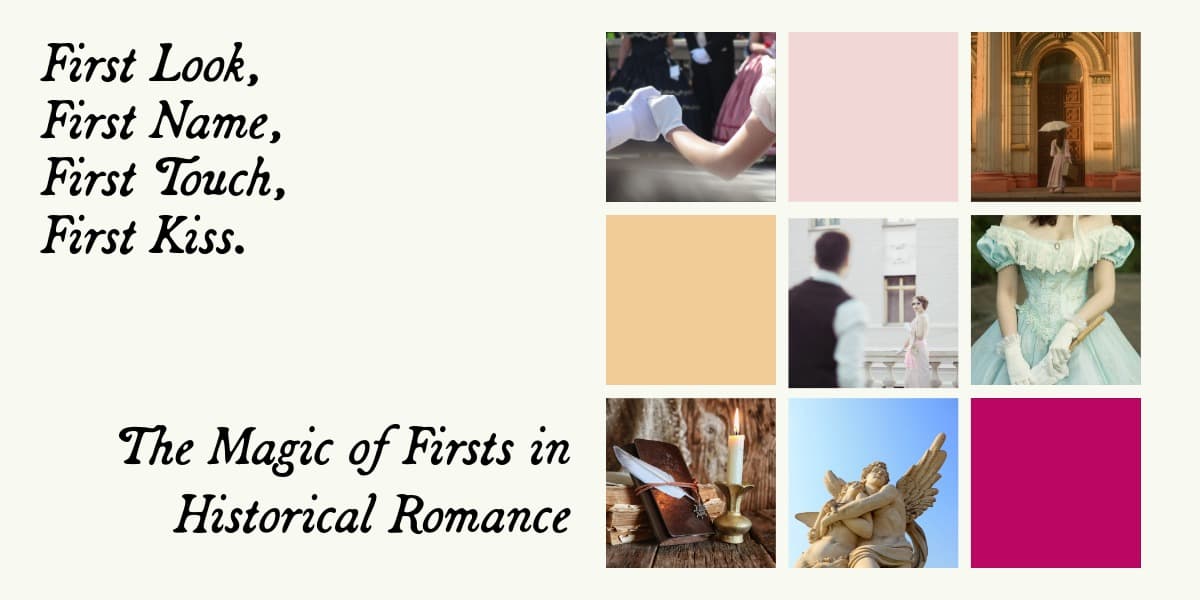
In a world that moves at breakneck speed, historical romance takes me back the rhythm we’ve lost. It takes moments that mean almost nothing in the modern world and elongates them until they become magical. A glance across a ballroom. A brush of fingers while passing a teacup. A first name spoken aloud for the first time. These are tiny things, but in a historical setting, they are seismic.
I’m not a plotter by any stretch, but I do keep a checklist of essential “firsts” for every romance I write that are based on social expectations and etiquette of the time. For me, these are the moments that anchor the emotional arc. They’re the beats that tell me where the tension lives, where the tenderness blooms, and where the story shifts. These are grounded in the rules of the time, but they aren’t about following the rules. They’re about building a love story that operates within the rules and restrictions of the period, because in historical romance, that’s where the magic is.
The First Look
For instance, a couple known to be attached to each other should never, unless when old acquaintances, be left alone for any length of time, nor be allowed to meet in any other place than the lady's home—particularly at balls, concerts, and other public places—except in the presence of a third party. This, as a general rule, should be carefully observed, although exceptions may occasionally occur under special circumstances; but even then the full consent of the lady's nearest relatives or guardians should be previously obtained.
George Routledge, Routledge's Manual of Etiquette at Project Gutenberg
Etiquette rules are quite clear about how to meet or make a first impression. With great difficulty. It’s a wonder anyone met and fell in love at all, because the rules around interactions were so strict. For women, the first interaction is about showing restraint and demonstrating modesty, while for men it’s a chance to demonstrate reserve and restraint.
In the real world, living within the rules of society, an individual did not know how a relationship might grow, so the rules around early interactions were incredibly strict. In a romance, we have the privilege of knowing how the story will end, even though the characters don’t know. The guaranteed happily ever after is what makes this moment so delicious for us, the reader.
A first look can do a lot of work. Within a few sentences, you should be able to:
· Describe some physical aspects of the character.
· Reveal what the Point of View character thinks of the other/s.
· Establish the connection that will shape their interactions.
· Evoke the historical period.
Love, like (or dislike) at first sight, reacquaintances after a long period of time, people who already know each other, the first look that happens on page doesn’t need to be about fireworks, but it is important that it follows through on a promise to the reader that was made in the blurb (or if you use them, in your promised tropes).
Instalove or lust? Hearts better be fluttering.
Enemies to Lovers? Show that emotion (with a hint that things will change). I like to show this as an undercurrent of respect from at least one of the characters.
Friends to Lovers? Let the reader see the emotional, platonic connection already shared by the characters.
No matter what your premise, the first look is all about giving your reader their first look into the dynamics of the characters they are about to spend a few hours with. It’s possibly the first promise you will fulfill to you readers, so do take the time to make it special. An example from A Song and a Snowflake:
A beat, a note, a soloist took up the tune, and he was lost.
Her delicate pink lips slipped over each note in a breathy embrace, a soft blush brushed her cheeks, and dammit if he couldn’t shake the feeling that she was singing to him, as if she understood the loneliness in his heart at being so far from home. The words were meant to be joyful, yet a melancholy attached itself to her melody. She reminded him of a trapped bird who knew it had been caught, and instead of fretting against the bars in search of an escape, only sought to enjoy its last few moments of peace before its wings were clipped.
First Name
Husbands and wives indicate pleasant conjugal relation existing where they address each other in the family circle by their Christian names, though the terms of respect, "Mr." and "Mrs.," may be applied to each among strangers. When speaking of each other among near and intimate relatives, they will also use the Christian name; but among general acquaintances and strangers, the surname.
From Thomas Hill, Hill's Manual of Social and Business Forms at Internet Archive
Possibly my favourite of these firsts is this one—permission to use the first name. It’s not only because it points to an important shift in the relationship between the two protagonists, but also because it’s a moment that requires some finesse to make it resonate with a modern reader.
Books written at the time by authors like Austen, Dickens or Trollope did not worry about this. There’s a reason we all refer to Mr Darcy and not the dashing Fitzwilliam, and it’s because for most of the story, Elizabeth talks about Mr Darcy. They aren’t close enough in the story to just say, oh, by the way, call me Fitzwilliam (and if Pride and Prejudice were set in Australia, it would be, call me Fitzy). The rules matter deeply and were understood by their contemporary readers. People who had known each other for a long time would still rely on formalities and titles. Even some married couples would still refer to one another as “Mr and Mrs” when alone, depending on how close they were.
But for those of us writing in this very twenty-first century era, casting back to the nineteenth, it’s a different situation to negotiate because our readers want to hold just one name in their head, but also, a more intimate name and a name that reflects our social convention of calling people by their first name. This moment is as important a moment for the reader as much as for the couple.
It’s a moment that does double duty in historical romance. Not only does it bring the characters closer, but it brings the characters closer to the reader. Here's my example from A Song and a Snowflake:
‘I’d prefer you call me Sinclair,’ he said, his voice a warm drizzle through the cold air. ‘My father is Mr McIntyre. It doesn’t sound right to my ears.’
‘Call me Charlise,’ she said, half turning towards him. ‘Your grandmother sounds fascinating.’
First Touch (without gloves)
Never be seen in the street without gloves; and never let your gloves be of any material that is not kid or calf. Worsted or cotton gloves are unutterably vulgar. Your gloves should fit to the last degree of perfection.
From The Habits of Good Society: a handbook of etiquette for ladies and gentlemen, at Internet Archive
Gloves were a very big deal in the class-conscious Victorian era. Etiquette demanded that gloves be worn at almost all times, and this applied to both men and women. Gloves needed to be in pristine condition, spotless, without a loose thread of a mark on them. However, it was impossible to keep light coloured gloves clean and as they were made from animal hide, they could not be washed. For those of the middle and upper classes who were bound to follow this social convention, this meant a constant supply of new gloves had to be purchased, with old gloves often being disposed of after one or two uses. Gloves were a kind of conspicuous consumption: a necessary, high quality yet constantly disposed of item.
The reason gloves were so important was because hands were indicators of class. Rough hands were a sign that their owner engaged in (shock) manual labour and were therefore from the working class, whereas soft hands indicated scholarly labour, or none at all. Gloves protected hands from becoming rough. Even in small and seemingly gentle customs from this time, there is always a reinforcing of the divisions between class and gender.
Being seen without gloves was almost akin to being naked, and so touching without gloves can be a very intimate moment. No matter the heat of the book, this moment matters.
One of mine:
For a man not wearing gloves, heat still beat from his light hold around her bicep, each tiny indentation of his fingers like a brand through her sleeve.
First Kiss
Do not make any display of affection for even your dearest friend; kissing in public, or embracing, are in bad taste. Walking with arms encircling waists, or such demonstrative tokens of love, are marks of low breeding.
From Florence Hartley, The Ladies' Book of Etiquette, and Manual of Politeness, at Internet Archive
Historically, a kiss carries momentous weight. During a time when every physical touch or glimpse of skin is controlled and regulated, kissing does more than push against boundaries. It breaks right through, and if the couple is discovered, the consequences can be momentous.
For some authors, writing the first kiss comes easily, but not for me. I spend more time planning and choreographing the first kiss than on any other intimate scenes that follow. That’s because it marks a momentous shift in the relationship. I see it as a tipping point and a change in the power balance between the two. The dynamics between the couple might be flipped 180 degrees by a little kiss, and the story that follows is impacted by this moment.
One final example from A Song and a Snowflake:
‘There’s a tradition. If two people are caught beneath the mistletoe, they kiss.’
‘Tradition. Like a rule, then?’
‘I suppose. But you can’t just steal a kiss.’ Charlise said, a reprimanding hint to her tone, even as she took a small step into his shadow. ‘You pluck a berry first. When all the berries are gone, no more kisses.’
He reached above her, slowly, his fingers slightly fumbling as he held her gaze. ‘I pluck a berry?’
‘Yes.’
‘And then I can steal a kiss?’
Plotting firsts for writers who don’t plot
I’m not a great plotter. I don’t particularly like the word pantser either. I much prefer George RR Martin’s terms of architects and gardeners to describe those who spend lots of time planning the story before they start writing, and those who do a little less planning before they throw themselves into a draft. Because I do some planning—I don’t just crack open Scrivener and write one word after another. I generally have some guideposts planned out and use these to work out how the story will unfold.
This is where these four firsts come into play for me. Having a sense of what each of these might involve helps me to build out all the surrounding action. They are milestones that help me check the pacing and temper the relationship between the characters. It is also in these moments of small, grounded details that makes a good historical romance shine.
A Song and a Snowflake is free for subscribers to my newsletter. It not only shows each of these firsts in action, the story is heavily inspired by etiquette guides from the time. You can download your copy by signing up to my newsletter.